The End of Progress: Decolonizing the Normative Foundations of Critical Theory by Amy Allen
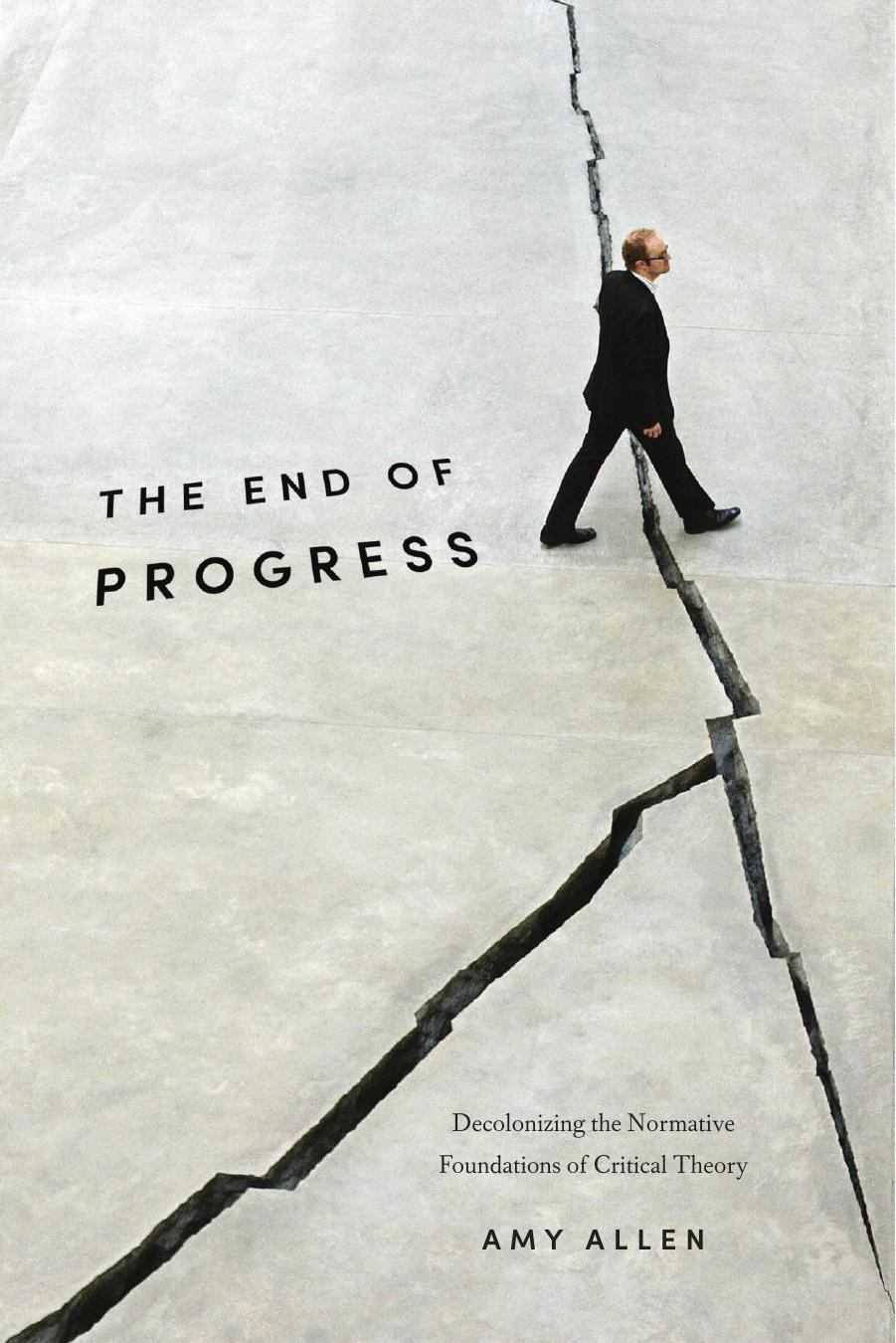
Author:Amy Allen
Format: epub, pdf
Tags: PHI040000, Philosophy/Movements/Critical Theory, PHI019000, Philosophy/Political
Publisher: Perseus Books, LLC
Published: 2015-01-11T16:00:00+00:00
PUTTING FIRST THINGS FIRST: POWER AND THE METHODOLOGY OF CRITICAL THEORY
In the previous section, I argued that Forstâs conception of practical reason obscures rather than illuminates reasonâs various entanglements with certain kinds of power relations, particularly with forms of authoritarianism and subjection that are found in various relations of subordination and that assume particularly pernicious forms in the context of colonialism. And yet, Forst himself insists that what distinguishes his framework for critical theory from alternatives is its ability to foreground questions of power (JC, 109â125). As he puts it, the first question of justice is the question of âthe justifiability of social relations and the distribution of the âpower of justificationâ within a political contextâ (RJ, 11). This insight is central to a critical theory of justice, which insofar as it is critical must also be radical, that is, it must uncover the roots of social injustice. The first good of a critical theory of justice is therefore âthe socially effective power to demand, question, and provide justifications, and to turn them into the foundations of political action and institutional arrangementsâ (RJ, 11). Hence a critical theory of justice that puts the issue of justification at its center is one that, as Forst puts it, puts âfirst things first,â where this means that it puts the issue of âjustificatory powerâ first (JC, 120). Justice, Forst rightly insists, is a matter not of the distribution of goods but of the subjection of some individuals to the domination or arbitrary rule of others.32 Thus the first question of justice is the question of power.
And yet, it is far from clear that Forst succeeds in putting first things first. The reasons for this have mainly to do with Forstâs conceptualization of power. In The Right to Justification, Forst tends to present justificatory power as something normatively positive and empowering, and to link it to the ability on the part of subjects of domination or arbitrary rule to demand justification for their situation. In this vein, he claims that justificatory power is âthe highest good of justice (though one that cannot be distributed like a material good)â and he defines it as âthe âdiscursiveâ power to provide and to demand justifications, and to challenge false legitimationsâ (RJ, 196). As a result, his formulation of justificatory power in that text is open to the criticism that it overemphasizes reasonâs emancipatory potential and underemphasizes the subordinating power of justification, that is, the ways in which conceptions of practical reason and practices or orders of justification can and do serve to entrench, rationalize, and legitimate relations of domination by defining female, queer, and subaltern subjects as irrational or unreasonable.33 However, Forst claims in response to this line of criticism that his more recent work articulates a more complex and ambivalent conception of power that is attentive to both the empowering and the subordinating effects of justificatory power (JJ, 178).
In this recent work, Forst continues to equate power with justificatory power, though he now describes such justificatory power in normatively neutral terms.
Download
The End of Progress: Decolonizing the Normative Foundations of Critical Theory by Amy Allen.pdf
This site does not store any files on its server. We only index and link to content provided by other sites. Please contact the content providers to delete copyright contents if any and email us, we'll remove relevant links or contents immediately.
| Anthropology | Archaeology |
| Philosophy | Politics & Government |
| Social Sciences | Sociology |
| Women's Studies |
Cecilia; Or, Memoirs of an Heiress — Volume 1 by Fanny Burney(32558)
The Great Music City by Andrea Baker(32018)
Cecilia; Or, Memoirs of an Heiress — Volume 2 by Fanny Burney(31956)
Cecilia; Or, Memoirs of an Heiress — Volume 3 by Fanny Burney(31941)
We're Going to Need More Wine by Gabrielle Union(19046)
All the Missing Girls by Megan Miranda(16024)
Pimp by Iceberg Slim(14506)
For the Love of Europe by Rick Steves(14121)
Bombshells: Glamour Girls of a Lifetime by Sullivan Steve(14073)
Talking to Strangers by Malcolm Gladwell(13370)
Norse Mythology by Gaiman Neil(13363)
Fifty Shades Freed by E L James(13239)
Mindhunter: Inside the FBI's Elite Serial Crime Unit by John E. Douglas & Mark Olshaker(9339)
Crazy Rich Asians by Kevin Kwan(9291)
The Lost Art of Listening by Michael P. Nichols(7506)
Enlightenment Now: The Case for Reason, Science, Humanism, and Progress by Steven Pinker(7311)
The Four Agreements by Don Miguel Ruiz(6765)
Bad Blood by John Carreyrou(6621)
Weapons of Math Destruction by Cathy O'Neil(6279)
